So let's run the actual numbers.
Every quarter, our sales team reviews what's moving fastest across our wholesale client base: the repair chains ordering 200–500 units monthly, the regional distributors supplying independent shops, the multi-location operations that track their margin per repair job the same way a restaurant tracks margin per table. The iPhone 14 vs iPhone 15 conversation comes up constantly right now because both models are in high-volume repair territory, the wholesale prices are meaningfully different, and the customer charge potential diverges in ways that aren't always obvious.
What follows is the margin analysis we run internally. We're publishing it because we believe buyers who understand the full picture make better sourcing decisions - and better sourcing decisions tend to become long-term relationships.
Why This Comparison Matters in 2026?
To understand why these two models are the right comparison right now, you need to understand where they sit in the repair lifecycle.
The global smartphone repair market is projected to reach $22.66 billion in 2026, growing at approximately 8% annually through 2035, driven by consumers choosing repair over replacement as device prices rise. Within that market, screen repair consistently represents the largest single category - screen repair and replacement comprised 40% of all repair types in 2023, and that share has held steady.
The iPhone 14 series launched in September 2022 and is now entering what the industry calls the "peak repair window" - devices are old enough to have accumulated damage, users have already decided to keep them rather than upgrade, and wholesale parts prices have stabilized after the post-launch premium period. The iPhone 15, launched September 2023, is about 12 months behind that curve: repair volume is growing fast, prices are still slightly elevated, and the margin structure is actively shifting.
The question isn't which model is "better." It's which one, right now, in your specific market, puts more money in your pocket per screen job.
Section 1: Wholesale Cost Comparison - What You're Actually Paying
Let's start with what you're paying at the factory level, because this is where the margin equation begins.
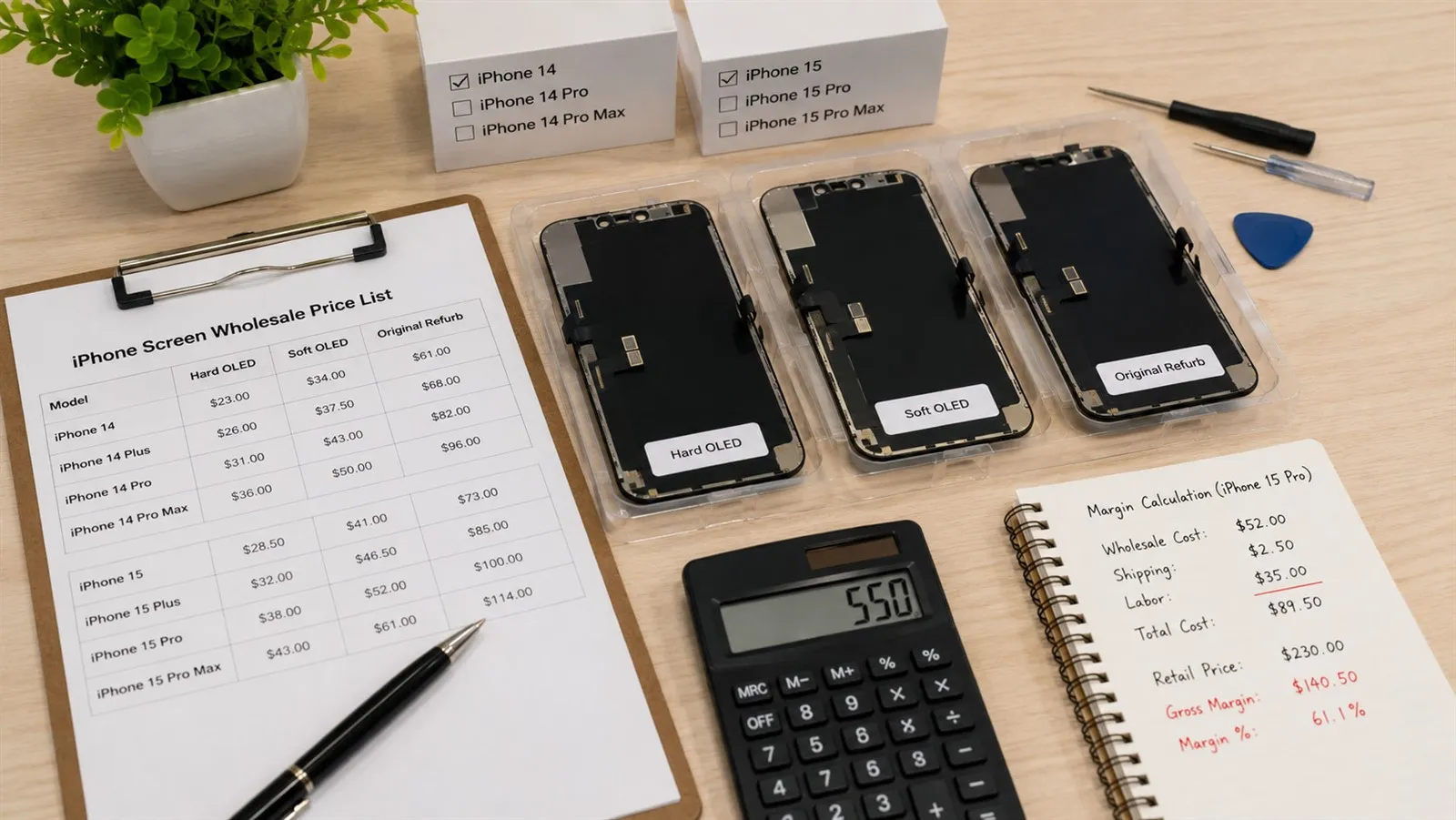
iPhone 14 Series - Wholesale Prices (FOB Shenzhen, May 2026)
| Model | Hard OLED (MOQ 50) | Soft OLED (MOQ 50) | Original Refurb (MOQ 20) |
|---|---|---|---|
| iPhone 14 | $23.00 | $34.00 | $61.00 |
| iPhone 14 Plus | $26.00 | $37.50 | $68.00 |
| iPhone 14 Pro | $31.00 | $43.00 | $82.00 |
| iPhone 14 Pro Max | $36.00 | $50.00 | $96.00 |
iPhone 15 Series - Wholesale Prices (FOB Shenzhen, May 2026)
| Model | Hard OLED (MOQ 50) | Soft OLED (MOQ 50) | Original Refurb (MOQ 20) |
|---|---|---|---|
| iPhone 15 | $28.50 | $41.00 | $73.00 |
| iPhone 15 Plus | $32.00 | $46.50 | $85.00 |
| iPhone 15 Pro | $38.00 | $52.00 | $100.00 |
| iPhone 15 Pro Max | $43.00 | $61.00 | $114.00 |
The gap on like-for-like models: iPhone 15 standard runs roughly $5.50–$7.00 more per unit than iPhone 14 at Soft OLED grade. For Pro models, the gap widens to $9–$11 per unit.
At 100 units per month, that's $550–$1,100 more in monthly parts cost for 15-series. That difference has to be recovered in higher customer charges, higher volume, or lower returns - and the data tells a clear story about which scenario is playing out in the market.
Section 2: What Repair Shops Are Actually Charging Customers?
Parts cost only matters in context of what you can charge. Let's look at real market pricing.
Third-party repair shops typically charge 20–40% less than Apple for common repairs like screen and battery replacements. Apple charges $279 for iPhone 14 screen repair and $329 for iPhone 15 Pro Max - third-party shops typically run $220–$270 for the same job.
From our wholesale client data across shops in the US, UK, Germany, and Australia, here's what independent repair shops are charging in 2026 for screen replacement (Soft OLED grade, all-in):
Independent Repair Shop Retail Pricing - Customer Charge (May 2026)
| Model | US Market | UK Market | German Market | Australian Market |
|---|---|---|---|---|
| iPhone 14 | $145–$180 | £120–£155 | €135–€170 | A$210–A$260 |
| iPhone 14 Pro | $175–$220 | £145–£185 | €160–€200 | A$255–A$315 |
| iPhone 14 Pro Max | $195–$240 | £165–£205 | €180–€225 | A$285–A$345 |
| iPhone 15 | $165–$210 | £140–£175 | €155–€190 | A$245–A$295 |
| iPhone 15 Pro | $205–$255 | £170–£215 | €190–€235 | A$300–A$360 |
| iPhone 15 Pro Max | $230–$280 | £195–£240 | €215–€260 | A$335–A$395 |
These are the ranges we see from clients who share pricing data - the spread reflects geographic market competition and shop positioning. Budget shops in competitive high streets sit at the lower end; shops with strong review profiles and less local competition sit at the upper end.
Section 3: The Margin Calculation - Model by Model
Here's where it gets interesting. Let's build a clean margin comparison using a consistent methodology: Soft OLED grade (the most commonly stocked for current-gen models), MOQ-50 wholesale pricing, US market retail charge at the midpoint, and a standard $35 labor cost.
iPhone 14 Standard
- Wholesale cost: $34.00
- Shipping allocation per unit: ~$2.50
- Labor: $35.00
- Total landed cost: $71.50
- Customer charge (US midpoint): $162
- Gross margin per job: $90.50 (55.9%)
iPhone 15 Standard
- Wholesale cost: $41.00
- Shipping allocation per unit: ~$2.50
- Labor: $35.00
- Total landed cost: $78.50
- Customer charge (US midpoint): $187
- Gross margin per job: $108.50 (58.0%)
iPhone 14 Pro
- Wholesale cost: $43.00
- Shipping: $2.50
- Labor: $35.00
- Total cost: $80.50
- Customer charge: $197
- Gross margin: $116.50 (59.1%)
iPhone 15 Pro
- Wholesale cost: $52.00
- Shipping: $2.50
- Labor: $35.00
- Total cost: $89.50
- Customer charge: $230
- Gross margin: $140.50 (61.1%)
The pattern is clear: iPhone 15 delivers higher absolute margin per job and a modestly better margin percentage across every model comparison. The $7 higher parts cost is more than offset by the $25–33 higher customer charge the market is currently supporting for 15-series repairs.
Section 4: Volume - Which Model Has More Repair Jobs Right Now?
Margin per job only tells half the story. The other half is how many jobs per month you're actually doing.
This is where iPhone 14 currently has the edge.
Based on the order volume data from our wholesale clients:
The iPhone 14 series entered its peak repair window in late 2024 and is now at maximum demand velocity. Devices are 3+ years old, screens are cracking at the highest rate in their lifecycle, and users who bought the 14 at launch have largely decided to hold rather than upgrade to the 16. We're seeing iPhone 14 standard and 14 Pro as the top two models by volume in our wholesale orders for Q1 2026.
iPhone 15 repair volume is growing fast - approximately 35–40% quarter-over-quarter in our shipping data - but it's starting from a lower base. Devices are only 2.5 years old, and the natural damage accumulation curve means the repair peak is still 9–12 months away.
In 2023, 72 million smartphones were repaired in the US due to cracked screens, up 18% from 2022 - and that trajectory hasn't reversed. Both models are riding a growing market. But right now, iPhone 14 is where the volume is.
Practical implication: If you're choosing one model to stock heavily, iPhone 14 currently offers higher stock turnover and fewer cash-flow risks from slow-moving inventory. iPhone 15 offers better margin per job but potentially slower velocity depending on your market.
The sophisticated answer - which our highest-volume clients have landed on - is to stock both, with iPhone 14 as your primary volume model and iPhone 15 as a margin optimization layer.
Section 5: Grade Strategy - Where the Real Margin Lives
The model comparison is only part of the picture. Within each model, grade choice has a larger impact on margin than the model difference itself.
45% of US consumers report they would pay extra to have their device repaired using original or OEM-quality parts - and in practice, this willingness-to-pay is highest on current and near-current models like the 14 and 15 series.
Here's what grade strategy looks like in practice for a shop running both models:
Scenario A: Stock only Hard OLED (lowest cost)
- iPhone 14 standard: $23 wholesale → $145 charge → $87 margin (60%)
- iPhone 15 standard: $28.50 wholesale → $155 charge → $89.50 margin (57.7%)
Scenario B: Stock Soft OLED (quality positioning)
- iPhone 14 standard: $34 wholesale → $162 charge → $90.50 margin (55.9%)
- iPhone 15 standard: $41 wholesale → $187 charge → $108.50 margin (58.0%)
Scenario C: Offer Original Refurbished as premium upsell
- iPhone 14 standard: $61 wholesale → $219 charge → $120.50 margin (55.0%)
- iPhone 15 standard: $73 wholesale → $245 charge → $134.50 margin (54.9%)
The takeaway: Soft OLED delivers the best combination of margin percentage and customer acceptance. Hard OLED looks better on margin percentage alone but leaves money on the table because most customers in 14/15-era repairs are willing to pay for visible quality. Original Refurbished is a genuine upsell tool - not a volume product, but worth carrying for the customer who specifically asks about genuine parts.
For repair shop owners, screen sourcing cost is the most controllable variable in margins. Sourcing directly from wholesale suppliers rather than local distributors typically saves 15–30% per screen. This is where factory-direct pricing creates meaningful structural advantage over buying from domestic distributors.
Section 6: The iPhone 14 Pro / 15 Pro Dynamic Island Factor
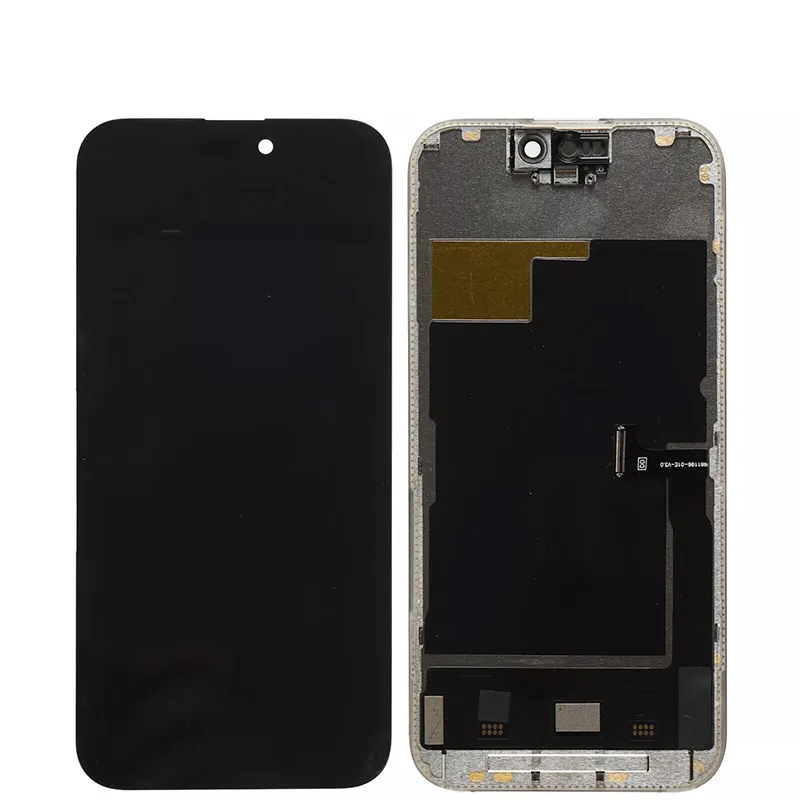
One sourcing nuance that matters specifically for Pro models: the Dynamic Island cutout, introduced on the iPhone 14 Pro and carried through 15 Pro, makes panel alignment more sensitive than earlier models.
Cheaper panels with loose manufacturing tolerances produce visible gaps or slight misalignment around the Dynamic Island cutout - customers on Pro models are more likely to notice this because the cutout is a highly visible design feature. We've tracked a modestly higher return rate on Pro models sourced from lower-tier factories specifically attributable to this issue.
For Pro and Pro Max models, the jump from Hard OLED to Soft OLED isn't just about display quality - the Soft OLED specification also requires tighter dimensional tolerances during manufacturing, which reduces Dynamic Island fitment issues. If you're stocking 14 Pro or 15 Pro at scale, we recommend Soft OLED as your default grade rather than treating it as a premium option.
Section 7: Price Trajectory - What Happens to Margins Over the Next 12 Months
Buying decisions made today need to account for where prices are heading, not just where they are now.
iPhone 14 trajectory: Parts prices have largely stabilized. We don't expect significant further decline in 14-series wholesale pricing over the next 6–9 months - supply and demand are roughly balanced. Retail charge prices in the market may soften slightly as the devices age, but the demand volume will remain strong through at least mid-2027. This is a stable, predictable category.
iPhone 15 trajectory: Based on historical patterns from the 13 and 14 series, iPhone 15 parts will decline approximately 15–20% in wholesale price over the next 12 months as supply matures and iPhone 17 drives the next upgrade cycle. This has two implications:
First, iPhone 15 parts purchased at current prices will be worth less in 6 months - buy to match your velocity, not to stockpile. Second, as wholesale prices fall while retail charges drop more slowly, the margin per job on 15-series repairs will improve over the next 12 months. Shops that build their iPhone 15 sourcing capability now will be positioned better as the model enters its own peak repair window in late 2026 to early 2027.
iPhone 16: We're in the early premium phase on 16-series parts. Supply is still maturing, prices are elevated, and we recommend limited initial inventory until prices stabilize - likely Q3 2026. Don't let the margin optics on paper lead you to overstock early-lifecycle parts that are harder to move if pricing drops sharply.
Section 8: The Verdict - Which Model, and How to Stock It
Based on the margin analysis, the volume data, and the price trajectory:
For maximum current profitability: stock both, but differently.
iPhone 14 is your volume engine right now. It's in peak repair demand, turnover is fast, and the margin per job is consistent and predictable. Stock 14 standard and 14 Pro as your primary inventory, in Soft OLED grade. These two models should represent the majority of your iPhone screen investment in H1 2026.
iPhone 15 is your margin optimizer and future-positioning play. Stock it at lower depth now - enough to cover demand without sitting on inventory - and increase depth as the model ages and repair volume grows through late 2026. The margin per job is already better than 14-series, and it's going to improve as parts prices decline.
If you're in a premium market (UK, Germany, Australia, North America high street), add Original Refurbished inventory for both models in smaller quantities. Even if it's 10–15% of your volume, the customer conversations that product enables - and the review quality that comes from genuinely premium repairs - compound into long-term competitive advantage.
The Stocking Formula We Recommend
For a shop doing 150–200 iPhone screen repairs per month across all models, here's the inventory allocation we'd suggest based on current market conditions:
| Model | Grade | Monthly Units | Rationale |
|---|---|---|---|
| iPhone 14 | Soft OLED | 35–45 | Peak volume, stable margin |
| iPhone 14 Pro | Soft OLED | 20–30 | High margin, strong demand |
| iPhone 14 Pro Max | Soft OLED | 10–15 | Lower volume, highest per-job margin |
| iPhone 15 | Soft OLED | 20–30 | Growing demand, better margin/job |
| iPhone 15 Pro | Soft OLED | 15–20 | Premium market positioning |
| iPhone 14 (Refurb) | Original | 5–8 | Upsell tool, premium customers |
| iPhone 15 (Refurb) | Original | 3–5 | Upsell tool, true-tone conscious buyers |
Total: 108–153 units monthly - a sensible stock depth that turns in 30 days without cash flow risk.
A Final Note on Sourcing Strategy
The margin analysis above assumes factory-direct wholesale iPhone screen sourcing at the prices we've listed. If you're buying through domestic distributors or multiple middlemen, your actual cost basis will be 15–30% higher, and the margin calculations above will compress accordingly.
The difference between sourcing from a wholesale supplier directly versus local distributors typically saves 15–30% per screen - at 150 units per month at $34 average cost, that's $765–$1,530 per month that stays in your pocket rather than a distributor's margin.
That's the structural difference between treating sourcing as a transaction and treating it as a business strategy.